18th Aug, 2026| 5 Min read.
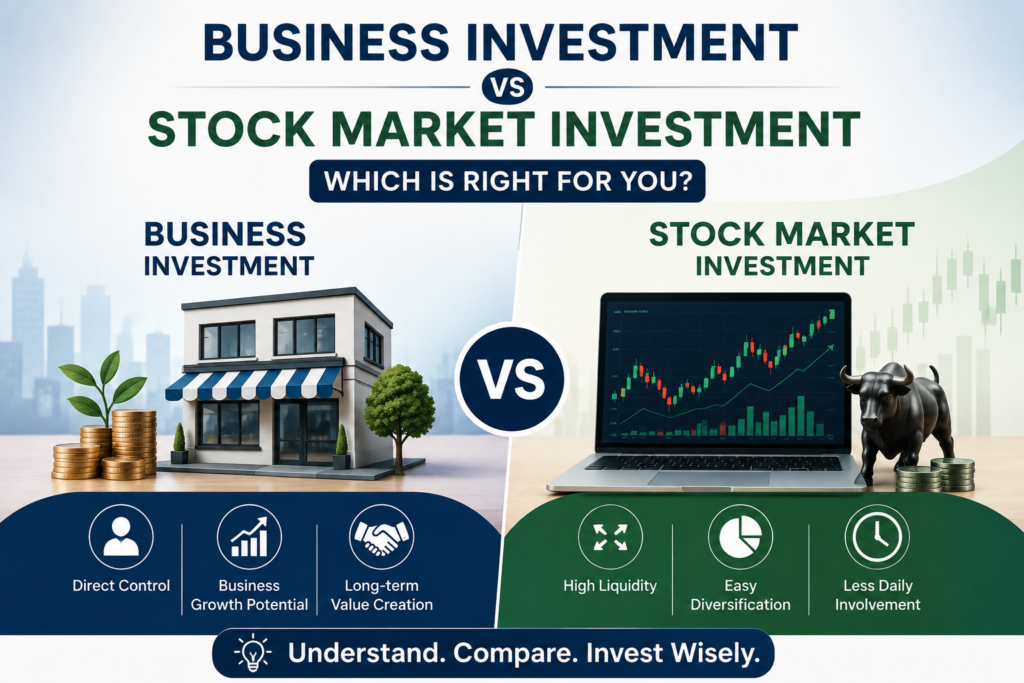
Business Investment vs Stock Market Investment: Which Is Better?
When you have money to invest, one common question is: should you invest in a business or put your money into the stock market? There is no single answer that works for everyone. A business investment can give you direct ownership and greater involvement in an operating business. A stock market investment allows you to ...
When you have money to invest, one common question is: should you invest in a business or put your money into the stock market?
There is no single answer that works for everyone.
A business investment can give you direct ownership and greater involvement in an operating business. A stock market investment allows you to own shares of companies without managing their day-to-day operations. The right choice depends on your capital, risk tolerance, time, business knowledge, investment goals and how actively you want to be involved.
For someone who wants to build or acquire a business, investing in a running business can be an interesting alternative to simply buying financial assets. On the other hand, investors who prefer liquidity and less day-to-day involvement may find the stock market more suitable.
Let’s compare both options in simple terms.
What Is Business Investment?
Business investment means putting money into an operating business, acquiring an existing business, buying a share in a company or investing in a business opportunity with the expectation of earning a return.
For example, you may invest in:
- A running retail business
- A manufacturing unit
- A restaurant or food business
- A service business
- A technology business
- A hospitality business
- A rental or accommodation business
- A growing private company
- An existing local business
When you invest in or acquire a business, your returns may come from business profits, increased business value, future growth or eventually selling your ownership.
The major difference is that you are investing directly in a business rather than simply buying shares that trade in the market.
What Is Stock Market Investment?
Stock market investment means buying shares or other securities through the securities market.
When you purchase shares of a company, you become a shareholder. Your investment value can increase if the share price rises, and some companies may distribute dividends, although dividends are not guaranteed.
Stock prices can also move up and down because of company performance, economic conditions, market sentiment and other factors. There is no guaranteed return from equity investment.
For this reason, investors should consider their goals, investment horizon and ability to handle losses before investing.
Business Investment vs Stock Market Investment
The biggest difference is control and involvement.
With a business investment, you may have a direct role in the business and its decisions, depending on the ownership structure.
With stock market investment, you generally have much less involvement in daily business operations. You are investing in the company’s ownership through shares.
Here is a simple comparison:
| Factor | Business Investment | Stock Market Investment |
|---|---|---|
| Ownership | Direct or private ownership | Ownership through shares |
| Daily involvement | Can be high | Usually low |
| Control | Potentially higher | Usually limited |
| Liquidity | Often lower | Generally higher for actively traded shares |
| Research required | Business, financial and legal checks | Company and market research |
| Income potential | Business profits and growth | Price appreciation and possible dividends |
| Risk | Business-specific and financial risks | Market and company-specific risks |
| Time commitment | Can be significant | Usually much lower |
| Exit | May take time to find a buyer | Shares can generally be sold through the market |
| Knowledge required | Business operations and industry | Financial markets and company analysis |
The table shows why these two investments are very different even though both are made with the expectation of generating returns.
Which Has Higher Returns: Business or Stock Market?
This is one of the most searched questions, but there is no fixed answer.
A successful business can potentially generate substantial returns because the owner may directly influence sales, expenses and growth.
At the same time, a business can lose money or even fail.
Stocks can also generate significant long-term returns, but prices can fall and returns are never guaranteed.
Therefore, it is not accurate to say:
“Business investment always gives higher returns.”
It is equally incorrect to say:
“The stock market is always better.”
The potential return depends on the specific business or investment, purchase price, management, market conditions, time horizon and risks involved.
Business Investment vs Stock Market: Which Is More Risky?
Both can be risky, but the type of risk is different.
When you buy a running business, you may be exposed to operational risks such as:
- Employees
- Customers
- Suppliers
- Rent
- Competition
- Cash flow
- Business liabilities
- Regulatory requirements
When you invest in stocks, you are more exposed to:
- Share price volatility
- Market-wide movements
- Company performance
- Economic conditions
- Investor sentiment
The important thing is to understand the risk before investing rather than simply looking at the potential return.
Which Is Better for a First-Time Investor?
For a first-time investor, the answer depends heavily on personal circumstances.
If you have:
- Strong business experience
- Knowledge of a particular industry
- Sufficient capital
- Time to manage a business
- Ability to conduct due diligence
then acquiring a running business may be worth exploring.
If you:
- Prefer passive investing
- Want easier liquidity
- Have limited business-management experience
- Want to diversify across companies
- Do not want daily operational responsibility
then stock market investment may be more suitable.
There is no requirement to choose only one.
Some investors may decide to build a diversified investment portfolio while also using their experience and capital to acquire or invest in a business.
Should You Invest in a Running Business or Stocks?
Ask yourself these questions before deciding.
Do You Want to Run a Business?
If the answer is yes, business investment may be more interesting.
Do You Want a More Hands-Off Investment?
If yes, stocks may fit better.
How Much Capital Do You Have?
Buying an established business can require significantly more capital than starting a small stock portfolio.
How Much Risk Can You Handle?
Both options carry risk. Your decision should reflect how much loss you can realistically afford.
How Much Time Can You Give?
A business may require daily attention. Stock investing generally requires much less operational involvement.
Do You Understand the Investment?
This is perhaps the most important question.
Do not invest simply because someone says an opportunity will generate high returns.
Research the investment, understand the business model and assess the risks.
What Should You Check Before Investing in a Business?
If you decide to explore business investment, do not stop at the asking price.
Check:
Financial Performance
Review revenue, profit, expenses and cash flow.
Liabilities
Find out about loans, unpaid dues, tax obligations and other commitments.
Assets
Verify machinery, equipment, inventory, property rights and other assets included in the transaction.
Customers
Understand how the business gets its customers and whether revenue depends heavily on a few clients.
Employees
Check the number of employees, salaries, key personnel and whether important staff members are likely to stay.
Legal Documents
Review registrations, licenses, agreements, ownership documents and other relevant paperwork.
Business Valuation
The asking price should be compared with the actual financial performance, assets, liabilities and future potential of the business.
BizzXchange also provides business-related services including business valuation and due diligence, which are relevant considerations when evaluating an acquisition or investment opportunity.
What Should You Check Before Investing in Stocks?
If you choose the stock market, avoid investing purely because of a social-media tip or short-term market excitement.
Before investing, consider:
- Your financial goals
- Investment horizon
- Risk tolerance
- Company fundamentals
- Business model
- Revenue and profitability
- Debt
- Valuation
- Industry conditions
- Diversification
Due diligence should be part of the investment process. Understanding the company and reviewing relevant financial information can help you make a more informed decision.
Business Investment vs Stock Market Investment: Quick Summary
If you want control and active involvement, consider exploring business investment.
If you want liquidity and less operational involvement, the stock market may be more suitable.
If you have industry experience, a running business may give you an opportunity to use that knowledge.
If you want diversification, the stock market can make it easier to spread investments across different companies and sectors.
If you want to build and grow something yourself, business ownership may be more attractive.
If you want to invest without managing employees or customers, stock market investing may be a better fit.
Neither option is automatically better.
How BizzXchange Can Help You Explore Business Investment Opportunities
For people interested in business investment, the first challenge is often finding suitable opportunities to evaluate.
BizzXchange provides a platform for exploring businesses available for sale or investment. Buyers can identify their requirements, search business opportunities using available filters, review listings and connect with sellers or express interest.
The platform includes opportunities across different industries and locations, making it possible to compare businesses based on factors such as business nature, industry, established year, equity offered and other available listing information.
You can explore business investment opportunities on BizzXchange and compare available businesses based on your requirements.
Remember that an online listing is only the starting point. Financial, legal and operational information should be independently verified before entering into any transaction.
BizzXchange can help you discover businesses available for sale or investment and compare opportunities before you take the next step.
The best investment is not necessarily the one promising the highest return. It is the one you understand, can afford, and can manage within your risk level.
This article is for general educational purposes and should not be treated as financial or investment advice. Investment decisions should be made after considering your individual circumstances and, where appropriate, taking professional advice.